
If you’ve been dealing with tiny white ants in your Cocoa Beach kitchen or bathroom and can’t seem to get ahead of them, you’re dealing with one of the more frustrating pest problems in coastal Florida. Ghost ants are small enough to pass through gaps that most insects can’t use, fast enough that trails disappear before you can follow them, and structured in a way that makes standard ant treatments largely ineffective. They’re not impossible to control, but they require a different approach than most homeowners expect.
Cocoa Beach’s coastal humidity gives ghost ant colonies everything they need to stay active year-round. Understanding why they keep appearing is the starting point for actually doing something about it.
What Makes Ghost Ants Hard to Control
Most ant species operate from a single nest with a single queen. Ghost ants don’t work that way. A ghost ant colony typically runs multiple queens across multiple satellite nesting sites, often spread between the indoors and the outdoors at the same time. Treating one location doesn’t collapse the colony. It may not even reduce the visible activity for long, because the remaining queens simply ramp up reproduction elsewhere.
That structure also means ghost ant colonies can split in response to a perceived threat, a behavior called budding. When foragers encounter a repellent or contact insecticide and carry that signal back, part of the colony may relocate rather than die off. You end up with more nesting sites than you started with. It’s a counterintuitive outcome, and it’s one of the main reasons store-bought sprays tend to make ghost ant problems worse rather than better.
Why Humidity Keeps Them Coming Back
Warm, humid conditions are what this species is built for, and coastal Florida delivers that year-round. They nest in areas where moisture accumulates consistently — moist soil near the foundation and wall voids near plumbing are the most common locations indoors. Mulch in landscaped beds and potted plants brought inside are also common nesting sites that homeowners don’t always think to check.
In Cocoa Beach specifically, the combination of ocean air, frequent rain, and irrigation systems means that moisture-friendly conditions are rarely absent. Ghost ants don’t need to find a perfect environment. They just need one that’s good enough, and coastal properties give them that in most months. Addressing moisture conditions around the exterior of the home is part of any long-term ant control strategy here, not just an optional add-on.
How to Identify Ghost Ants
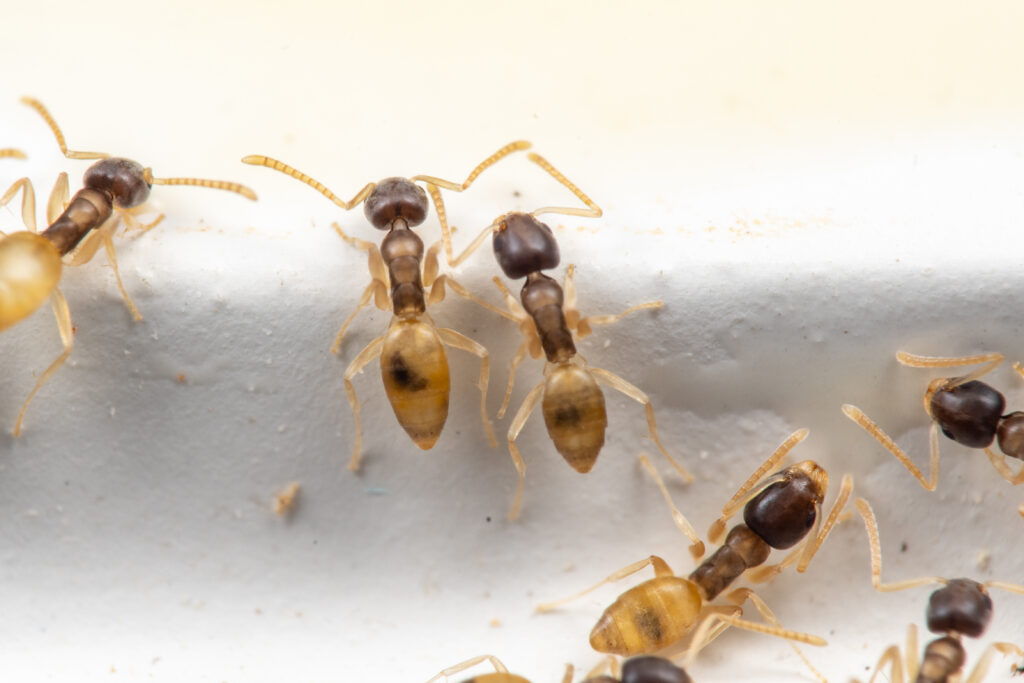
Sizing up ghost ants on sight takes some attention. At roughly 1.3 to 1.5 millimeters, they’re among the smallest ant species you’ll encounter in a Florida home. The name comes from their coloring: a dark brown or black head and thorax paired with a pale, almost translucent abdomen and legs. In motion, only the dark head is clearly visible, and the body seems to disappear. On a light-colored countertop or floor, a ghost ant trail can be easy to miss entirely at a casual glance.
They move quickly and tend to trail along edges rather than cutting across open surfaces, running along baseboards, countertop seams, and plumbing lines. Kitchens and bathrooms are the most common interior locations because both offer the moisture and food sources ghost ants prefer. Sweet materials are a particular draw, but they’ll feed on proteins and grease as well, especially during certain times of the colony’s development cycle.
Ghost Ants vs. Other Tiny White Ants
Misidentifying ghost ants is easy when several other small species turn up in the same homes. White-footed ants are slightly larger with pale feet rather than a fully translucent lower body. Crazy ants are a reliable behavioral tell: they move erratically rather than in defined trails, which distinguishes them quickly from the orderly lines ghost ants form. Pharaoh ants have a distinctly yellowish tint rather than the ghost ant’s near-transparent appearance and tend to show up in larger, more obvious colonies.
Getting the identification right matters because the treatment approach differs between species. Our resource on Florida biting ants covers several of the species most commonly found in Brevard County homes if you want more detail on distinguishing between them.
How We Treat Ghost Ant Infestations
Before any treatment goes down, we confirm the species and identify where the colony is operating, both indoors and out. Because ghost ants maintain multiple satellite nests, treatment has to account for the full network, not just the trail you can see in the kitchen. Interior activity is usually a sign of outdoor colonies using the structure as a foraging area rather than a colony nesting entirely inside the walls.
We use bait-based treatments that foragers carry back to the colony and share with the queens and larvae. That’s the mechanism that actually reduces the population rather than just displacing it. Interior crack-and-crevice applications address nesting in wall voids and plumbing areas, and exterior perimeter treatment creates a barrier and interrupts the trails connecting outdoor colonies to the inside of the home. Our pest control services cover ghost ants as part of our general pest program for Cocoa Beach properties.
Why DIY Products Miss the Colony
Contact killers are what you’ll find on most store shelves, and they have a specific limitation with ghost ants. They eliminate the workers they touch but don’t reach the queens or the workers inside the nest. For a species where queens are distributed across multiple locations, killing foragers on a trail doesn’t reduce the colony’s reproductive capacity at all. The visible activity may drop for a day or two, then return to roughly the same level as before.
Repellent products carry an additional risk with ghost ants specifically. Rather than dying off, portions of the colony may bud and relocate in response to the repellent, creating new satellite nests in untreated areas of the home. A problem that started in the kitchen can migrate to bathrooms, closets, or wall voids elsewhere in the structure after a repellent treatment. If you’ve noticed ghost ant activity spreading to new areas after a DIY attempt, that’s likely what happened.
Get Ant Control in Cocoa Beach
Ghost ants don’t respond to the same treatments that work on most other ant species, and Cocoa Beach’s coastal conditions keep the pressure consistent through most of the year. If you’re seeing them in your home, a targeted approach that accounts for the full colony structure is what actually moves the situation in the right direction.
Reach out to our team at 321-340-3205 or through our contact page to schedule a free estimate. We provide pest control in Cocoa Beach and throughout Brevard County: