
Removing a wasp nest yourself is dangerous in most situations. Wasps can sting multiple times, and a partial DIY treatment leaves an agitated colony behind without eliminating it. Professional removal is the right call for any large, enclosed, or hard-to-reach nest.
Finding a wasp nest on your property puts most homeowners in the same spot: you want it gone, and you want it gone now. A can of wasp spray from the hardware store looks like the obvious solution.
For small, exposed nests with low activity, it sometimes works. For everything else, it’s how people end up in the ER. Florida’s wasp species don’t give much warning before they respond. The risks get underestimated every season.
Why Wasp Nest Removal Is Dangerous
A wasp nest is an active colony with workers whose only job when threatened is to defend it. Unlike bees, wasps can sting multiple times without dying. A single disturbed nest can produce dozens of stings in seconds. For most people, that means pain and swelling. For someone with an undiagnosed allergy, it can mean anaphylaxis — a severe, potentially life-threatening allergic reaction.
Most DIY wasp nest removal attempts fail the same way: the nest doesn’t get treated completely on the first try. A partial treatment stirs up the colony without eliminating it. The wasps that survive are now fully defensive and the homeowner is standing close enough to get hit.
At that point, the situation is more dangerous than before the attempt started. Wasps that survive a failed treatment don’t calm down and go back to normal. They stay on high alert.
How Wasps React When Threatened
One sting marks you with a pheromone that signals the rest of the colony to hit the same target. Pain is the least of it. The more stings land, the stronger that signal gets. Running doesn’t help much. Wasps are fast and they pursue, and the pheromone lingers long after you’ve left the area.
The spots wasps choose to build make retreat difficult. Roof eaves, soffits (the flat surface under the roof overhang), spaces inside the walls, and ground burrows all put the homeowner close to the nest with limited room to back away. An underground yellow jacket nest is the worst version of this. By the time you realize what’s happened, you’re already being stung.
Which Wasp Species Are in Florida?
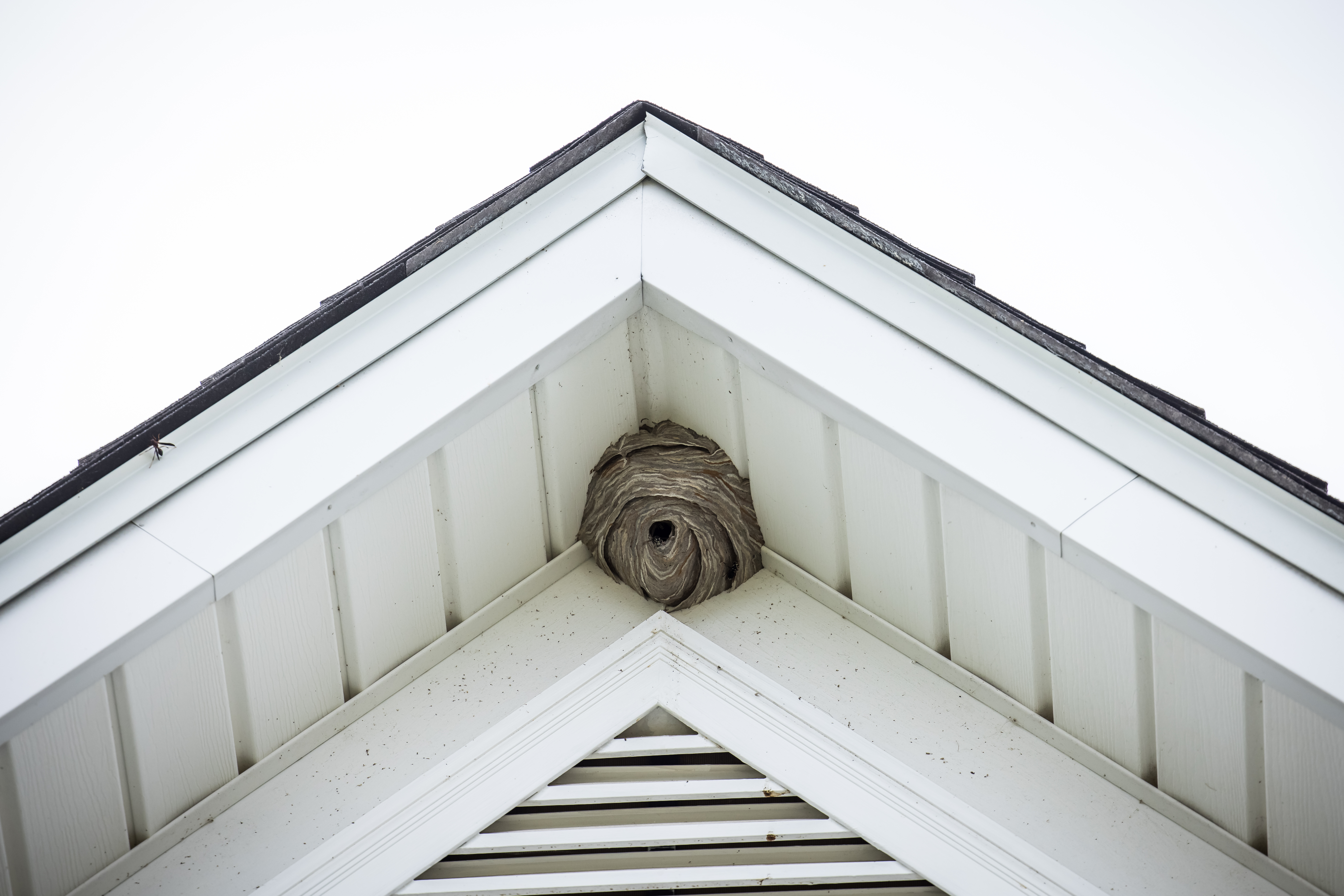
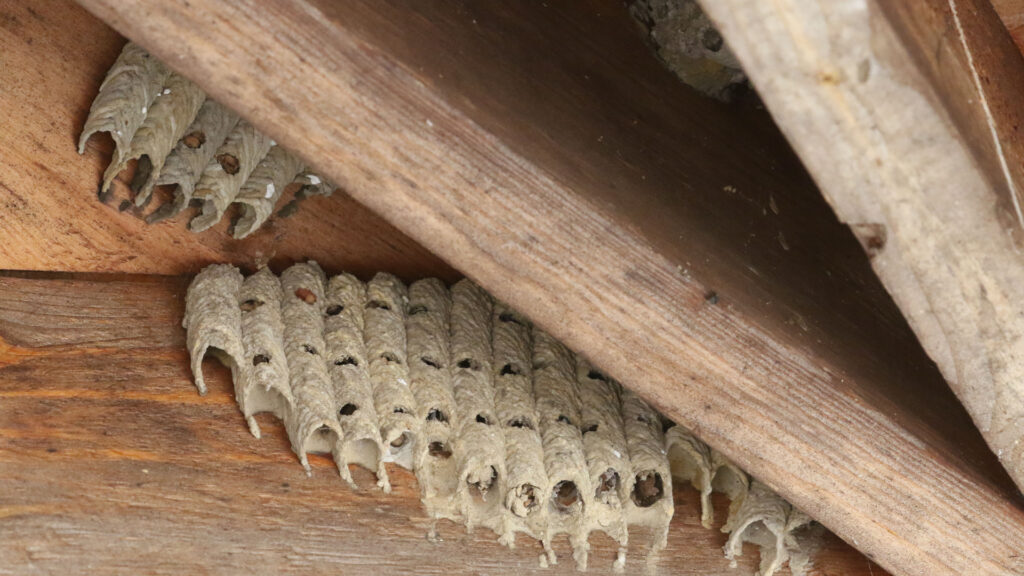
Not all Florida wasps behave the same way. Knowing which species built the nest you’re looking at changes whether you approach it at all. Our guide to the different types of wasps in Florida covers identification in depth, but here’s what matters most for nest removal decisions.
The open, umbrella-shaped nests you see under the roof overhangs (eaves) and porch ceilings are almost always paper wasps. They’re the most common nest builder around Florida homes. They’re defensive but not highly aggressive unless the nest is directly disturbed.
A paper wasp nest tucked under a soffit away from foot traffic is a different situation from one directly over a doorway or near a kids’ play area.
Those tube-shaped mud nests on garage walls and ceilings belong to mud daubers. They’re generally non-aggressive and rarely sting. An abandoned mud dauber nest poses almost no risk. An active one is still worth professional removal if it’s in a location where it’s regularly disturbed.
There are five types of wasps homeowners in Florida commonly encounter, and they don’t all require the same response.
If you’re seeing a very large, solitary wasp and aren’t sure what it is, there are a few giant wasp species in Florida worth knowing.
Are Yellow Jackets More Aggressive?
Yes, and significantly so. Ground nesting, large colonies, and fast response to vibration make yellow jackets the species most likely to cause a serious sting incident.
Their ground nests are often invisible until you’re too close. You can mow over one or step near the entrance without any warning. Late summer and fall colonies are at peak population. Peak population means peak aggression.
Yellow jacket nest removal is not a DIY job. The colonies are large and the nests are often buried or inside a wall. They respond to vibration faster than paper wasps do. If you’ve found a yellow jacket nest on your property, the right call is to hire a professional for removal.
For more on yellow jacket stings and what to do if you’ve been hit, our page on yellow jacket stings that won’t stop hurting covers what’s actually happening and when it’s a medical concern.
Bald-faced hornets are equally aggressive. They sting repeatedly and aren’t a DIY removal job.
When Should You Call a Professional?
A large nest, a nest in an enclosed space, an unidentified species, anywhere you can’t retreat quickly if it goes wrong. Any one of those is a call for professional wasp removal. A small paper wasp nest in an open spot you can treat from a distance is the one scenario where DIY sometimes works. Even then, timing and full protective gear matter.
Florida’s wasp season peaks in summer and early fall. That’s also when most families are spending time outside. A nest near a play area, a pool, or a walkway isn’t one to gamble on. The cost of professional removal is lower than that of an ER visit.
The risk of a serious allergic reaction is real, even for people who have been stung before without a major response. Sensitivity can develop over time, and a large sting event is a different situation from a single sting years ago.
What Does Professional Wasp Removal Include?
Species identification and nest location determine everything else: what product gets used, what protective equipment is needed, and how the technician approaches the nest. Ground nests, nests inside walls, and open aerial nests are all handled differently. A technician who treats a yellow jacket ground nest the same way as a paper wasp eave nest is cutting corners.
Treatment involves applying a fast-acting insecticide directly into the nest entrance. The timing matters: most of the colony is inside in the early morning or evening, which makes those windows the most effective. The nest is then removed once the colony is confirmed inactive.
For nests inside walls or in the attic, the access point may need to be sealed after treatment to prevent reinfestation at the same location next season. Knowing when wasps are most active helps time the service for best results.
Orange Pest Handles Wasp Removal
Don’t let a wasp nest become an emergency. If you’ve found a wasp nest on your property, we handle the removal safely and completely.
Call us at 321-340-3205 to schedule a service. We know Florida’s wasp species, have the equipment to treat nests safely in any location, and seal entry points to reduce the chance of a new colony moving in next season.
We proudly serve homeowners across: