
Ghost ants keep returning because surface treatments miss the colony. These ants have multiple queens and split into new colonies when threatened, which means repellent sprays spread the problem instead of solving it. Effective control uses slow-acting bait that workers carry back to reach the queens.
You clean the counter, wipe out the cabinet, and maybe spray something from the hardware store. The ghost ants disappear for a few days. Then they’re back, usually in a slightly different spot or in higher numbers than before. The colony is almost never where you think it is. That’s what makes ghost ants so hard to get rid of. Surface treatments barely scratch it.
What Are Ghost Ants?
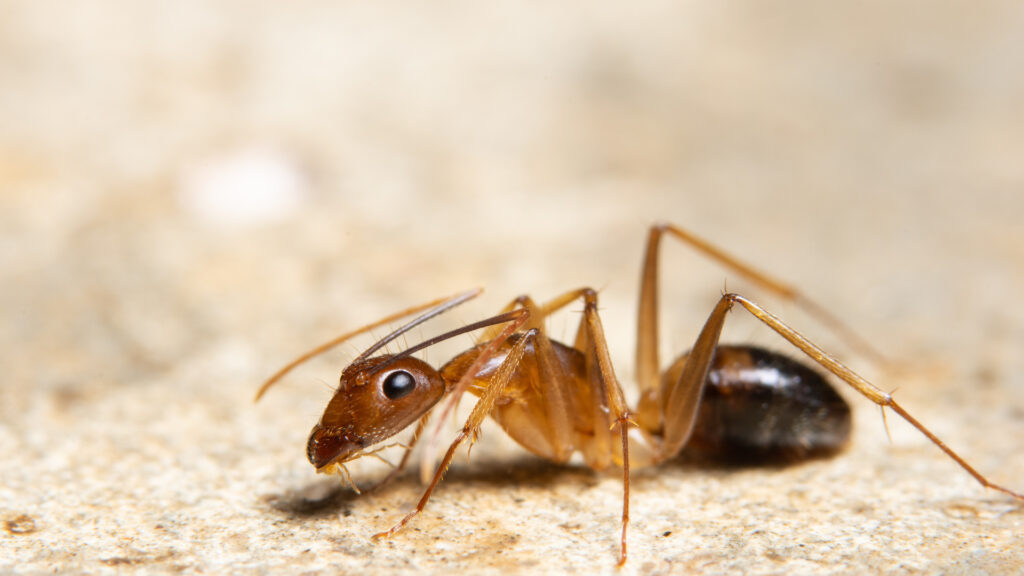
Ghost ants have been established in Florida for decades, spreading through warm, humid coastal areas. They’re native to Africa and Asia. Follow a trail and it vanishes into a wall gap or cabinet hinge with no obvious entry point. That disappearing act is where the name comes from. Ghost ants don’t behave like most species, which can be traced back to a single entry point.
Coastal communities like Cocoa Beach see especially high ghost ant activity because of the consistent humidity.
Outside, ghost ants nest in soil, leaf litter, and under objects on the ground. Inside, they move into spaces inside the walls, insulation, potted-plant soil, and any small, humid cavity near food or water. A single colony can have multiple queens and multiple nesting sites. That’s a large part of why eliminating them completely is so difficult.
They don’t build the raised ant hills you’d see from fire ants. Their outdoor colonies are flat and hidden under debris.
What Do Ghost Ants Look Like?
Ghost ants are very small, about 1.3 to 1.5 millimeters long. That’s roughly the size of a period on a printed page. Their heads and midsection are dark brown to black, but their abdomen and legs are pale, almost translucent. That two-tone coloring makes them hard to see on light-colored surfaces, and the pale abdomen seems to disappear entirely on white countertops.
Florida carpenter ants grow much larger, sometimes reaching half an inch, and can show up in the same home.
Crush one and you’ll get a faint coconut or musty smell. That’s a fast field test when you’re not sure what you’re dealing with. Ghost ants move in erratic, fast-changing trails rather than the steady lines you’d see from fire ants or carpenter ants. Small size, pale lower body, and scattered movement make for a reliable match.
Ghost ants are one of the more difficult Florida ant species to control because of how their colonies are structured.
Our guide to Florida biting ants also covers other species you might confuse them with.
What Attracts Ghost Ants Indoors?
Moisture is the primary draw. Ghost ants need water to survive. They seek out dripping faucets, condensation around pipes, humid bathrooms, and any area with standing water. Kitchens and bathrooms are their preferred indoor zones for this reason.
A slow drip under the sink or a bathroom that stays humid from poor ventilation creates exactly the conditions they look for. In Florida, those conditions exist in most homes most of the year.
Food is the secondary draw, and ghost ants aren’t picky. Sweet foods draw them most reliably: sugar, honey, syrup residue, ripe fruit, and anything sticky left on a counter. When sweet options aren’t available, they’ll go after grease residue on stovetops or pet food. A scouting ant that finds both moisture and food nearby doesn’t leave. It leaves a scent trail back to the colony.
What Do Ghost Ants Eat Indoors?
Inside the home, ghost ants forage for the sticky residue produced by small plant pests like aphids on indoor plants. Houseplants are a less obvious attractant, but a consistent one. They’ll work through the soil of a potted plant while also farming any insects on the leaves. A heavily infested plant can support ghost ant activity entirely on its own.
In kitchens, they target open food packages, spilled cooking oils, crumbs under appliances, and the residue inside empty bottles and containers. A recycling bin with unrinsed bottles is a reliable food source that goes unnoticed for weeks.
Ghost ants are small enough to fit into gaps in packaging that larger species can’t reach. A container that looks sealed to you isn’t always sealed to them. Threads on a jar lid, a crimp in a bag seal, a loose cap: any of those gaps work.
How to Get Rid of Ghost Ants
Workers pick up gel bait and carry it back to the colony, where it spreads to queens and larvae (the young ants still developing in the colony). That’s what makes it effective against ghost ants when surface sprays aren’t. A surface spray kills the workers you see and stops the foraging trail, but the colony survives and rebuilds. Bait reaches the colony. That’s the difference.
Place bait directly on or next to active trails, not in open areas. Ghost ants won’t detour from a trail to find a bait station. Cabinet hinges, under sink pipes, and along baseboards where you’ve seen trailing are the right spots. Small placements in the right locations beat large placements in the wrong ones every time.
Why Ghost Ants Are Hard to Control
Two things set ghost ants apart from most species: multiple queens and a behavior called budding. When a colony feels threatened (a repellent spray, a partial treatment, or a significant disturbance), a queen and a group of workers split off and form a new satellite colony somewhere else in the home. You don’t eliminate the colony. You multiply it.
Repellent sprays make ghost ant problems worse for exactly this reason. Any treatment that scatters the colony rather than eliminating it triggers budding. The more you disturb without resolving, the more satellite colonies you end up with.
Professional ghost ant control uses non-repellent products (treatments that don’t push ants away before they pick up the active ingredient) and slow-acting baits specifically to avoid this response. For more on how Florida’s rainy season pushes ants indoors and makes them harder to keep out, our post on ants in the house when it rains in Florida is worth a read before the next storm season.
Stop Ghost Ants With Orange Pest
If ghost ants keep coming back, the colony hasn’t been reached. We use non-repellent baits and targeted applications that get to the source rather than just pushing ants from one room to the next.
Call us at 321-340-3205 to schedule a ghost ant inspection. We serve Brevard County and surrounding areas with treatments built around Florida’s ant species.
We proudly serve homeowners across: